Sunday, 25 May
We gather in Heathrow Terminal 4 for the non-stop
British Airways flight to Tokyo. Many re-acquaintances are made from
previous tours and cruises. We take off on time and spend 11 hours in
the air, over Estonia, Siberia (north of Lake Baikal) and eventually
descending into Narita Airport.
Monday, 26 May
In a sense it is an overnight flight, but as our routing
is so far north, the sun never stops shining on the port side. We land
on time at 09.10 - we are now eight hours ahead of BST.
Entry formalities and luggage collection are quick
and easy, and soon we are aboard our coach. With us are Chris Cook,
birding guide now resident in Tokyo, and Mr Uoshi, ground agent. Luckily
there is time for a legstretch and exploration of Yatsu Higata Park
on the way to Haneda Airport. In cool, cloudy conditions, we look over
an area of tidal mudflats. Waders are dotted here and there, and with
the help of three scopes, we find many species of special interest.
Among a small group of Great Knot are a few Red-necked Stints, well
into breeding plumage. A Mongolian Plover feeds on the far side with
two Kentish Plovers. Right in front of us are Grey-tailed Tattlers,
both in breeding and winter plumage. The only duck is a Spotbill at
close range. A noisy Oriental Reed Warbler appears in the reeds below
us, while a family of Azure-winged Magpies give good views behind us.
Also seen from the coach as we press on are Brown-eared Bulbul, Grey
Starling and Asian House Martin. A brief look at Tokyo birds, but a
good one! We see plenty of industrial estates, but no temples or other
points of note along the way, except a number of the famously efficient
bullet trains, (all parked).
At Haneda Airport we check-in for the Kushiro flight,
and enjoy a good meal in one of the many airport restaurants. Haneda,
though principally the domestic airport, seems larger and busier than
Narita. The 90-minute flight (with ANA, or All Nippon Airways) is in
an almost empty 767. Immediately we are struck by the late season: we
are at 43°N, (the same as Northern
Spain!), and yet most of the broadleaved trees are still leafless. Cherry
trees are in pink blossom, and the air is chilly. Within a mile of the
airport, we see a pair of Hokkaido's most famed and beautiful bird:
Red-crowned Cranes, feeding in a small marsh beside the road. Many Latham's
Snipe are perched on poles or display-flighting along the road into
town, Slaty-backed Gulls are a common sight, nesting on the rooftops
outside the hotel. Just before 18.00 we arrive at the Hotel Ana, (run
by the airline), where the rooms are very comfortable.
There is time to unpack and bath, before dinner in
a restaurant across the road. An earth tremor shakes the hotel for a
few seconds. Mr Uoshi offers bottles of Italian wine to go with the
meal. Fresh fish is on the table, for us to barbecue as we like: Peter
emerges as head-chef. There are vegetables, seafoods, miso soup, ice
cream and strawberries: a real welcome dinner!
Tuesday, 27 May
After breakfast from a well-stocked buffet, we set
out to the east on a misty morning. The seafront at Akkeshi has Greater
Scaup, and Black-tailed Gull to compare with the abundant Slaty-backs.
Oriental Greenfinches put in a brief appearance on a grassy bank, and
a Black-backed Wagtail shows startling white wings in flight. Chris
and Uoshi-san buy our picnic lunches at a supermarket. The gardens still
have daffodils in flower.
We make for the Kiritappu Marshes, and stop at a viewpoint.
A single Red-crowned Crane is feeding at the water's edge below us,
and a few Sika Deer bound away into cover. At the visitor centre, there
is plenty of activity in the woodland edge. Olive-backed Pipit display-flighting,
Siberian Stonechats and a Brown Flycatcher all give good views. An Eastern
Crowned Warbler is busy in the canopy, and there are brief views (for
the lucky ones) of Japanese Grosbeak and Hawfinch.
Since it is good weather for brass monkeys, we decide
to have our picnic in the spacious coach. Most of the group are adventurous
trying out a variety of Japanese delicacies, but there are sandwiches
and biscuits on hand for the others. The afternoon walk skirts along
the edge of the marsh. Japanese Bush Warbler is heard everywhere, including
a short, rich phrase that gives its nickname of Japanese nightingale.
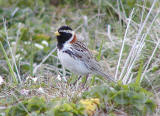
The star bird of the walk is Long-tailed Rosefinch, which gives us all
fine views, and there are plenty of Black-faced Buntings. One or two
lucky ones at the front see the Japanese Robin, out in the open, that
Chris points out. This is a usually a real skulker in dense undergrowth,
with the orange not confined to the breast as in "our" robin,
but all over the head. A Wryneck calls up on the hill, and a Black-browed
Reed Warbler appears in a bush in the marsh. Plants that attract attention
include butterbur and skunk-cabbage, white Trillium and various
sizes of Primula.
Luckily visibility has been good while we have been
in the field, but on the journey back the fog descends again. Dinner
is a pasta spectacular, with eight different dishes brought one after
the other. We catch up with our sightings by doing a two-day checklist.
Wednesday, 28 May
Daylight begins early here: 03.30 according to reliable
reports. It gets dark about 19.00. As we breakfast, fog turns magically
to sunshine. We leave the Hotel Ana at 08.00, with all our luggage,
bound for the Akan National Park, north of Kushiro.
First stop is at Lake Takkobu, in perfect conditions:
what a change from the wintry day yesterday. As we walk along the lakeshore
road, birdsong is loud. Siberian Rubythroat (a beauty!) and Black-browed
Reed Warbler stay put in the scopes. Commonest species, with dominant
songs, are Black-faced Bunting and Eastern Crowned Warbler. Chris points
out the squeaky-gate song of Sakhalin Leaf Warbler, and in due course
a few give reasonable views. The back is brown, as opposed to the green
of the Eastern Crowned. Out on the water are several drake Falcated
Duck and one drake Smew among the Goosander. Both swifts appear together:
the Pacific, with white rump and forked tail, and the more heavily built
White-throated Needletail. This interesting swift nests in dead trees,
and has a habit of closing its wings and losing height while cruising
powerfully through the sky.
We take a coffee break at the nearby Hoosaka visitor
centre, which has a magnificent view over the extensive marshes where
the cranes can sometimes be seen. The woodlands are alive with cuckoo
song, both the familiar Eurasian one and the deeper Hoopoe-like tones
of the Oriental. Great Spotted Woodpecker and Nuthatch are here too,
at the far eastern edge of their enormous ranges. Japanese White-eyes
and Bush Warblers give brief views, but restlessly move on.
Retracing our route along Lake Takkobu, an adult
White-tailed Eagle causes a mass exodus from the coach. Flying above
us, it has to take evasive action from a Large-billed Crow. Careful
scanning reveals two more adults, perched around the shore. A Whooper
Swan flies right past us, a late migrant that perhaps was not strong
enough to depart with its mates.
Pressing on with the journey, we pass our closest
crane yet, feeding on another lakeshore. The road passes through a beautiful
lake district, further enhanced by the warm sunshine. The picnic spot
overlooks a crater lake: in fact, a flooded caldera. It will be remembered
for its obliging Bush Warbler, but not for its solitude. Groups of Japanese
tourists take turns at being photographed with the lake behind them:
this is the Windermere of Hokkaido. There is also an Asiatic Chipmunk
being hand-fed.
Next stop along our magical mystery tour is at Iousan,
a geologically active mountain with many volcanic steam vents. Terry,
familiar with such phenomena in Iceland, leads a group to inspect them
at closer quarters. A Japanese Wagtail gives a frustratingly brief view.
Another stroll through dwarf pine and Azalea reveals Oriental Greenfinch
in colourful display flight, and two Rufous Turtle Doves. Further on,
the undulating landscape opens out into potato fields and woodland edge.
Here a Bull-headed Shrike puts in a brief appearance.
The last part of the journey is in the Akan National
Park, along a twisty mountain road through mature mixed forest with
Sika Deer in view. At 18.15 we arrive at the lakeside resort and our
base for tonight, the New Akan Hotel. The huge, open-plan lobby-cum-dining
room is bustling with other cruise passengers and Japanese guests. Many
of them - men and women alike - are wearing spotted yukatas (cotton
robes) - provided in each room. Here we meet the last four in our group,
who join us after their own explorations on Honshu.
The buffet is huge and well stocked with all kinds
of Japanese food. Afterwards, Tony outlines plans for tomorrow, and
we call the log. On the top floor is a huge hot baths area, filled with
naturally hot water from the geothermal activity. Chris and I enjoy
a relaxing soak (with several Japanese guests) before bed.
Thursday, 29 May
After breakfast we visit Lake Onneto, a scenic spot
with forest and mountain reflections in the turquoise waters. Mandarin
Duck eventually give good views to all after sterling work by the beaters
(Steve and Ashley) who ensure that three males swim into view of the
scopes. These are the real Mandarins, neither escaped nor introduced!
Here is also a Siberian Blue Robin, which some of the group are able
to look down upon, as it perches between road and lakeside.
The surrounding forest is quiet for birding, in the
warm sunshine. But we enjoy a walk to a series of small waterfalls (of
warm water) admiring the diversity of the mixed forest. Among the most
obvious trees are maple, hornbeam, rowan, birch, fir and flowering Viburnum.
Sakhalin Leaf Warbler shows well, and Red-flanked Bluetail is heard
in two places. Peter finds a Jay of the rufous-headed Hokkaido subspecies.
By the waterfalls Tony comes across a non-venomous snake, but we only
know its Japanese name.
Passing a hungry Red Fox by the roadside hoping for
hand-outs, we stop in Akan to buy more drinks and picnic supplies. Lunch
picnic is at the Observation Centre overlooking Kushiro Marsh, where
a Large-billed Crow repeatedly flies off with huge quantities of surplus
rice - it is amazing it can still take off after many visits. One last
walk before heading off for the cruise produces a pair of Japanese Pygmy
Woodpecker, and three Latham’s Snipe display-flighting. It is interesting
to note that instead of drumming, the males vocalize with a sound like
air rushing from a tyre under pressure. Gabrielle also finds a shy Grey-headed
Woodpecker, and Steve comes up with a Red-cheeked Myna, a bird of open
country.
We arrive at the World Discoverer in good time at
16.30. She is a magnificent vessel, and we have a warm welcome from
the staff as we board. At this point we say farewell to Chris and Uochi-san,
who have worked hard for us over the last four days. We find our comfortable
cabins and attend a safety briefing before a buffet dinner. We set sail
promptly, heading north-east. A hundred or so Leach's Petrels fly alongside
the starboard side in the darkness, coming into the light enough to
make out white rumps. They give whistling contact calls. We have our
own welcome on board meeting, in which Tony and I provide glasses of
wine, and try to help the group orientate to the ship and life on board.
Tonight we leave Japanese waters and put our watches forward two hours,
(now BST +10).
Friday, 30 May
We are formally admitted to Russia in the early morning.
There is thick fog and a strong wind welcoming us to the Kurils: well,
nobody booked this cruise for the sunny weather! Yet after lunch, suddenly,
fog lifts, clouds part: here comes sunshine, and a wonderful backdrop
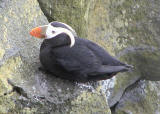
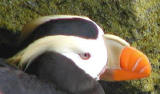
of volcanoes. Rhinoceros Auklets and Tufted Puffins are the first seabirds
to be seen, flying in small groups. A great shout goes up as a Spectacled
Guillemot appears, a rare and local auk, all black but for white spectacles
and red legs. In the next half-hour, several fly past, offering fine
views to all on the forward decks. We have stumbled upon a breeding
area by chance, as an anchor problem has forced us to seek a sheltered
bay. It seems that early this morning a length of discarded cable fouled
the anchor when the Russian immigration officers came aboard at Kunashir
Island.
We are offered a landing while the crew clear
the anchor. As the scout boat goes ashore to assess conditions, ten
White-tailed Eagles take to the air together. The bloated carcass of
a Steller’s Sea Lion on the beach is the reason for this amazing gathering.
One flies overhead shortly after we are all ashore. Behind the beach,
the terrain is almost impossible for walking, which prevents any exploration
of a promising wooded valley. Pacific Swifts fly over, and Oriental
Greenfinches feed on the valley floor. A Black-backed Wagtail is on
the beach. Ann puts us onto a Brown Thrush behind the landing beach:
this Kuril Islands breeder is closely related to the American Robin,
and has a similar colour scheme. The captain observes that as soon as
the shore is clear of zodiacs and people, the eagles return to their
meal.
We sail north, through the sunny evening, passing
the perfect cone of a 1,600m volcano to starboard. Tonight's delicious
dinner has an Italian theme, and is served as always with complimentary
wine and beer.
Saturday, 31 May
Sperm Whales are on our starboard side in the early
morning. We see the bushy, forward-facing blow and the great size, indicating
that they are adult males. The females stay in warmer waters with the
calves.
As we cruise past the island of Chernye Bratya, the
sea and sky are filled with seabirds. Huge numbers of Northern Fulmars,
of the dark morph, sit on the sea and fly past the cabin windows. With
them are Short-tailed Shearwaters, Tufted Puffins and Kittiwakes. Crested
Auklets fly up from the bows, small and dark, and fly past in dense
flocks. Among them are a few Whiskered Auklets, much less common and
usually associated with riptides. Red-faced Cormorants begin to appear
too, and Pigeon Guillemots, of the subspecies snowi, with no
white in the wing. For two hours the seabirding is spectacular, with
a backdrop of rugged volcanic scenery and smoking fumaroles at one point.
Steller’s Sea Lions can be seen in a pack in the water, staring nervously
at the ship; and two huge males are hauled out on a rock. The weather
conditions change constantly, with periods of sunny calm alternating
with fog patches and blasts of fierce wind.
During lunch, a small pod of Orcas passes by,
visible to many of the passengers without moving from their seats. The
male's huge dorsal fin can be seen from a great distance. In the afternoon
we have a zodiac tour round the sheltered side of Ostrova Broutona,
a small island with an enormous colony of Fulmars occupying every nook
and cranny. Below them are Kittiwakes paired up on their grassy nests.
Pigeon Guillemots and Harbour Seals allow approach close enough to photograph:
even to fill frames in some cases. A White-tailed Eagle flies over and
settles on a steep slope. Harlequins are a regular sight, either flying
low and fast, or diving in the kelp beds. One zodiac is lucky enough
to see a Long-toed Stint on a rocky shore. We see golden, scaly back
and yellow legs before it flies out of sight. Two Pelagic Cormorants,
with thin necks and dark bills, perch on rocks. The great swell makes
the transfer from zodiac to sidegate quite a hazardous experience. But
the abiding memory will be a sky filled with thousands of milling Fulmars.
Tonight is the Captain's Welcome Party and the magnificent
Captain's Dinner: a six-course meal with wine-glasses topped up all
the time.
Sunday, 1 June
After breakfast we have a zodiac cruise along the
shore of Ketoy Island, in calm, cloudy and mild conditions: in fact,
excellent weather for the Kurils. It is easy to hear Wrens singing along
the shore, and indeed some are seen as we try to find a Siberian Rubythroat
that keeps disappearing behind rocks. In the end two of our three zodiacs
see it well, just behind the beach. An Eastern Crowned Warbler is also
feeding on huge boulders above the beach. Black-backed Wagtails are
a common sight, flying with white wings like a Snow Bunting. Nutcrackers
are flying high above the scrub, a surprise habitat for them as there
are no conifers in sight. (Later, Cam Kepler - the ship's ornithologist
- tells me that there is a forest of stone pine on the plateau of Kepoy,
beyond our view). A Rough-legged Buzzard flies along the lofty crags,
past its nest built of sticks on a ledge. Other raptors are only seen
by a few of us: a distant White-tailed Eagle, and a Peregrine of the
dark subspecies peliae.
As for marine life, Harlequins are again a regular
sight along the kelp-beds close inshore, and there is an easily photographable
Red-faced Cormorant colony. Harbour Seals put heads and long whiskers
out of the water to watch us; another is hauled out on a rock.
As we set off for Yankicha Island, a Sperm Whale
appears but soon sounds, with an impressive display of its huge tail-flukes.
There are three in all: two very close to the ship. When they have dived
deep for another squid dinner, we know we will not see them for 20 minutes
or more - so we press on. Yankicha is shrouded in fog and strong wind,
unfit for landing zodiacs. But this doesn't dismay us, since we have
come to the world's centre of breeding Whiskered Auklets. This is one
of the rarest of the Pacific Alcidae, nesting on Yankicha's cliffs
and feeding in the tidal currents. Luckily their feeding grounds offshore
have clear visibility, and so we spend half an hour slowly cruising
through thousands of these fascinating little seabirds. They have a
wacky punk hairstyle, with drooping feathers pointing forwards over
their bills. This feature they share with the larger Crested Auklet
(which is also here in much smaller numbers): but the Whiskered has
three white plumes on the head, and a pale undertail. As they fly they
make a high-pitched mewing call. Also here are Tufted Puffins, all-black
Pigeon Guillemots, and the inevitable Fulmars.
As we continue our stately progress up the Kuril
chain, hundreds of Crested Auklets fly up from the misty bows. Peter
Matthiesson, the author, gives a lecture on tigers - only a Zen master
could get away with talking about tigers in the Kurils! Afterwards,
the Crested Auklet count grows fast: thousands can be seen (at once)
in one flock lifting off from the bows.
Instead of Yankicha, we have a landing at Mashua
Island, where possibly no birding has ever been done before. There are
plenty of old military remains, dating first from the Second World War
when it was occupied by the Japanese. After the bombing of Nagasaki,
the Russians occupied this desolate spot until six years ago. Before
we leave the ship, we watch a Steller’s Sea Eagle perched on a rock
on shore. This huge raptor with its great orange bill is a bird we all
especially wanted to see. On a patch of snow nearby, a White-tailed
Eagle feeds on some prey at its feet.
Once on shore, we explore with a sense of being pioneers.
Rubythroats are common along the shore, some singing, and others just
arrived on migration and busily feeding. A male Narcissus Flycatcher,
in bright yellow and black plumage, is also tired and feeding on insects
on the track ahead of us, between the dwarf alder bushes. A Rough-legged
Buzzard calls as it flies over the ridge. When Brian scopes the eagle
on the snow, the Steller’s has replaced the White-tail. As we watch,
out of nowhere stoops an angry Gyrfalcon onto the eagle. After two attacks,
it flies out over the sea and the ship, to an offshore island, where
we lose it among the seabirds. Ducks along the shore are mainly Harlequins,
but there are Teal and Goldeneye too.
The Russians have left a great deal of military equipment
lying about: old oil-cans, vehicles, pontoons, and piles of spent bullets.
Now the alder scrub is reclaiming the place, which is just changing
from winter to spring. It is amazing that we are at 47°
N, the same latitude as Milan and Venice, and yet the leaves are not
yet on the trees in June. We return for dinner after another great day
in the remote Kurils.
After dinner, Tony finds a Leach’s Petrel on deck,
disorientated by the lights in the fog. He rescues it, shows it to us
at the log-call, and releases it into the darkness. Ashley and Steve
have picked up two of the heavy steel helmets on shore, and present
them (with a military ceremony) to Kommanders Pymski and Simonov.
Monday, 2 June
Fog prevents our zodiac cruise at Skaly Lovuski, where
we hoped to float in among sea lions, fur seals and auklets. As we head
north, Fork-tailed Storm Petrels become more regular: grey and prion-like
as a first impression, with their erratic flight. Two schools of Dall's
Porpoise visit the ship, and ride the bow-wave for a short while.
There are lectures during the morning: first a botanical
one that has uproarious laughter coming out of the Discovery Lounge;
then one by Cam Kepler entitled "Wings over Arctic Waters."
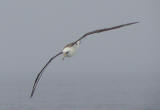
Between the two, the first Laysan Albatross flies along the port side,
where all the birders are congregating, sheltering from the wind. A
few Ancient Murrelets appear, at rest on the sea. The black and white
head pattern is different from anything else we have seen. Just before
lunch, a pod of Orcas passes alongside the ship, allowing brilliant
views as they synchronize their surfacing for air.
The afternoon landing is at Nima Bay on Onekotan
Island. As Steve and Gill leave the ship, a Red-throated Pipit flies
over them. In cold and windy conditions, we land on a black sand beach
close to a river mouth. The river is shallow enough to ford. Black-backed
Wagtails and Buff-bellied Pipits are numerous, and a few Teal and Wigeon
are flying about too. Up on the plateau, at first the botany is more
interesting than the birding, with only Skylarks and Reed Buntings being
obvious. Pines grow to less than a metre, and dwarf rhododendrons are
budding. After most of the group have come down the hill, Jeremy and
Gabrielle see a Japanese Grey Bunting which some other birders have
found. There are two Long-toed Stints along the stream, including one
at the mouth, which feeds on the green algae-covered rocks. When we
are all thoroughly chilled and ready for a hot drink, the zodiacs return
us to the warmth and comfort of our floating hotel.
Tuesday, 3 June
At Paramushir, it is not fog but strong winds that
foil our landing. This is a large, inhabited island with bears. As we
steam north to Atlasova, sea-watching is pleasant as the strong winds
have abated. A Laysan Albatross crosses the bows with about sixty passengers
watching. Among the auks, most are Tufted Puffins, with a few Crested
Auklets and Brunnich’s Guillemots. One White-billed Diver - sometimes
referred to as "the bananabill" - flies over the ship. There
are regular single Fork-tailed Storm Petrels, and one Leach's.
In late morning we are anchored off Atlasova, with
its snow-covered volcano, the highest in the Kurils, visible for a while.
There is a gulag here, an abandoned prison for Russian women
who (according to one story) committed the ‘crime’ of practising Christianity.
For a while there are problems embarking the zodiacs in the strong winds,
which seem to be associated with the islands, rather than the open sea.
But we still have time for three hours ashore,
to explore an area of lakes, scrub and hillside. Siberian Rubythroats
are in good song, and several are seen, usually on the ground, as it
is too windy for them to perch up and sing. Two Brown Thrushes feed
on the hillside above us: at last, good scope views for all. On the
lakes are Greater Scaup, Eurasian Wigeon, and one Mandarin drake, which
is a surprise in the Kurils. By going to the final lake near the gulag,
Steve finds Falcated Duck too.
Best of all, a shout goes up for Asian Rosy Finch,
a fine male feeding on the edge of a patch of snow up on the hill. Five
of us are there to watch it, as most of the group are already back on
board. A Peregrine comes over, and the Captain sounds the ship's siren
to call us back, as the wind is rising.
During dinner we head between Paramushir and Shumshu
Islands, in a narrow strait. We hoped for a zodiac cruise in the Ptichy
Islands, which are little more than rocks; but a force 7 wind spoils
that idea. Here is a Sea Otter stronghold, and we watch over 100 of
these engaging animals, as they lie on their backs. Some have young
alongside them, and they all watch us as we pass. One Pomarine Skua
crosses the bows, and a few Ancient Murrelets fly up from the water.
The wind howls outside, but the ship handles superbly, with its stabilizer
fins. The movement on board is comfortable for all the passengers.
Wednesday, 4 June
At breakfast we are at anchor off Utashud Island,
with Sea Otters round the ship, and two Steller's Sea Eagles flying
over. Once the zodiacs are launched for a cruise, the eagles disappear,
but the otters bob up and regard us with curiosity. Occasionally they
can be seen in more relaxed mode, lying on their backs. Harbour Seals
watch us too, both from the water and hauled out on a stony spit. The
island is a small, steep one, with nesting space for hundreds of Slaty-backed
Gulls, and various auks. Above the gulls, the grassy slopes make perfect
burrowing grounds for hundreds of pairs of Tufted Puffins. They are
constantly whirring above us in flight, and can be seen perched at the
entrances, like black-suited sentries. Pigeon Guillemots, here with
the usual wing-patch, are no longer the all-black subspecies of the
southern Kurils. A few Horned Puffins put in a first appearance, flying
into steeper cliffs for their nesting sites. Brunnich's Guillemots have
a small colony too. The low cloud and mist turns to rain and hail, and
those of us still out on the zodiacs are pelted by icy crystals.
Within an hour of departing, the weather changes totally,
and we cruise north (now along the Kamchatka coast) in lovely sunshine.
Nearby is Vestnik Bay, on the Kamchatka mainland, but our planned landing
there is ruled out by swell. Snowy volcanoes, far inland, are clear
to the top. There is a northward migration of Black-throated Divers,
which overtake us at regular intervals; likewise one small flock each
of Greater Scaup and Eurasian Wigeon.
As the sun warms us, we have a wonderful hour with
sightings of five of the most wanted birds and mammals, from the various
decks. Within three or four miles of coastline we have Steller’s Sea
Lions hauled out on rocks ahead of us, including enormous, thick-necked
bulls. On a pinnacle of the stack above them a pair of Steller’s Sea
Eagles have an eyrie. One sails round the sky, while the other attends
the nest. Orcas patrol the shoreline in menacing manner. Three Brown
Bears are seen, two dark and one blond, on the hillside near the eagles.
They are invisible when in the bushes, but they cross the snow-fields
and give themselves away. Round the corner a second Steller's eyrie
comes into view, occupied. As we sail into the next bay, Turkhurka,
another bear with three cubs scampers up the mountain slope. Sea Otters
approach the ship and seem more at ease than at Utashud. For future
reference, this stretch of coast with its wonderful wildlife is either
side of Russkaya Bay.
We make a landing at Turkhurka Bay, and walk on snow
in a wild and remote valley. Yellow Wagtails have just arrived, and
fly up with a buzzier call than we are used to in Europe. Three more
bears cross snow-fields on the mountainside above us: ten in a few miles
of coast. A third Steller’s eyrie has one bird sitting, and the other
standing heraldically on the next pinnacle: three eyries in the same
short stretch. A Eurasian Cuckoo sings, but that is one of the few signs
of spring. It is a very late season. There are Harlequins in the bay,
and Goosander fly downstream, but we feel that most migrants are yet
to arrive.
As we return to the ship after a sunny afternoon
outside, another fine dinner awaits us. The wintry Kamchatka coastal
scenery, with its perfectly shaped volcanoes, makes a perfect backdrop
to dinner as we head north.
Thursday, 5 June
Fog spoils the morning, or (according to your point
of view) gives a welcome opportunity to rest, send e-mails, etc. Long-billed
Murrelets with brown backs rise from the bows, and Pomarine Skuas head
north. As we anchor at the Little Chazma River in late morning, its
potential becomes obvious. There is a wide bay with many Black Scoter
and Greater Scaup in the shallows. Both Black-throated and Red-throated
Divers are about: Red-throated mostly on the water, and Black-throated
flying north. A pair of Steller’s Sea Eagles fly past the ship and one
lands on the closest hilltop.
Once we go ashore, the group splits into two. Tony
goes inland to look for passerine migrants, and comes across Olive-backed
and Red-throated Pipits. Willow Ptarmigan fly across the birch and alder
scrub; and along a marshy section, they put up Long-toed Stint. Red-necked
Phalaropes and a Wood Sandpiper feed in a grassy bog.
We keep to the shore, and come across a Brent Goose
of the dark American subspecies offshore, with many Pintail, Wigeon
and Harlequin. The Red-breasted Mergansers look wonderful in breeding
plumage. There are huge bear footprints in the sand. Anne finds us a
pair of Asian Rosy Finches, feeding along the snow-line: they become
a point of interest for some of the other birders. The last half of
our walk reveals a group of 44 Red-throated Divers, all pairing up and
displaying near the mouth of the Chazma River. This is a magical, wild
place with any amount of potential for interesting birds to turn up
in. As we leave to board the zodiacs, we have a choice of viewing: a
close Steller’s Sea Eagle up on the crags, half-filling the scopes,
or two Grey-tailed Tattlers on the offshore rocks.
We return to the ship for another delicious dinner.
Friday, 6 June
We are anchored off the mouth of the Zhupanova River
on a calm and bright morning. We are lucky to see the panorama of summits
free of cloud. There are pairs of Long-billed Murrelets on the glassy
water; but attention is drawn to the horizon. There is one volcano erupting
ash as we watch, Karimski. It is the only mountain that looks black,
as there is no snow on the lava-heated slopes. The black ash alternates
with puffs of white smoke and steam: here is a very angry volcano! Ring
of Fire is a good description of this area: did we not begin with an
earth tremor in Hokkaido?
The zodiacs drop us off on the bank of the Zhupanova
River. A Common Rosefinch greets us with a cheery ‘pleased to see
you.’ As we climb the hill into the mature birchwoods, a Steller’s
Sea Eagle perches on a bush below us, regal in the scopes. Olive-backed
Pipit is the commonest bird, and there are views of Rustic Bunting and
Grey-streaked Flycatcher. A Rough-legged Buzzard passes over, ghostly
pale against the blue sky. There is not much snow left on the ground
now, and plenty of new life for the botanists to study, including the
Trillium which will carpet the forest floor in white flowers
in a week or two. Now the sun is fully out, and we enjoy a perfect afternoon,
with temperatures up to 13°C.
Most of us return to lunch aboard, then split for
the afternoon. Our two zodiacs (with Cam and me aboard) cruise the channels
of the Zhupanova River. The tern colony at the mouth is at the courtship
stage: all are Common Terns of the black-billed eastern subspecies longipennis.
Sergei, the Russian Mr Fixit, steers the lead zodiac, and shows us two
occupied Steller’s Sea Eagle nests in mature birches on the river banks.
They are only a mile apart at most. Red-throated Divers rise up from
the river, where (as at Chazma) they are pairing off and courting. Suddenly
a huge white raptor appears, chased by crows. At first the impression
is Snowy Owl, but it turns out to be an almost white Goshawk, a peculiarity
of Eastern Siberia - so white that at first we believe it to be a pale
morph Gyrfalcon. Each time it flies the crows chase it relentlessly.
Shortly afterwards, a Hobby (tiny by comparison) flies over the zodiacs.
Heading back to the ship, we pass a Greenshank, a
close Cuckoo that calls its name at us, and one of the Steller's Eagles
returning to its eyrie. Not far from our course, we see a pair of Long-billed
Murrelets on the calm waters of the bay. Tea and cakes are a welcome
pleasure to return to: especially for those who take them out on deck
into the warm sunshine.
Meanwhile, Tony's party has to work hard, finding
little at first in the tundra that lies between the river and the hill.
But patience is rewarded by Brown Flycatcher, Arctic Warbler and Pechora
Pipit display-flighting all at the same spot. The pipit lands on a bush,
showing its white tram-lines, and sings its insect-like song.
Gabrielle, Brian and John have chosen to spend the
whole day at this magic place with a picnic lunch. In addition to the
other sightings we have seen, they can add Osprey, Japanese Grey Bunting,
Taiga and Siberian Flycatchers to the list. Before we leave, there is
a panic on the bridge when Lars Jonsson is discovered to be missing!
He would be a match for any bear with his great stature and huge tripod,
but the expedition team is glad when he safely appears.
In the Recap session, Alan discusses the decline
in Sea Otters, and Cam explains why Tufted Puffins can’t take off from
our bows but paddle along powerlessly. After dinner we compile the checklist
for the last two days, and watch a magnificent sunset behind another
panorama of volcanoes. About the same time 20 Red-necked Phalaropes
fly off from the bows, and a Russian submarine surfaces off the port
side.
Saturday, 7 June
At breakfast we are alongside the quay in Petropavlovsk:
a nice change from zodiacs and life-vests. It is a beautiful, cloudless
morning, with the sun yet to rise above the hills. We are soon on shore,
with seven of our group opting for a day in the field, while the others
have a morning in the city and join us in the afternoon. The city tour
visits the museum, a church recently built, a department store and some
of the city's statues.
The field group travels in a bus that takes us to
Sergei's kennels, where he keeps 35 husky dogs. He is hoping to enter
them for an international competition next year. This is our base, for
a barbecue lunch, a show of Koryak dancing, and for woodland walks morning
and afternoon. The birchwoods are about to burst into leaf. They are
home to Taiga Flycatcher, which we see at the nest hole, with two pairs
disputing ownership. This was formerly regarded as the eastern subspecies
of Red-breasted, but the red on the throat is much reduced. One of the
confusions brought about by its new name is that it sounds like an orange,
striped flycatcher that roars! Taiga, pronounced ‘tiger’, is in fact
the vast belt of Siberian birch and spruce forest that lies immediately
south of tundra. Rustic Buntings, Siberian Rubythroats and Common Rosefinches
are in good voice in these perfect weather conditions, and give us good
views during the morning. On the edge of a marsh a reeling song, like
a Grasshopper Warbler's but slower, can only mean Lanceolated Warbler:
it takes us 20 minutes to find, but Tony puts us onto it. Then, for
a long time, we admire this skulker for several more minutes. At least
when singing these secretive Locustella warblers do show themselves.
The barbecue of pork and salmon, with salads, soft
drinks and local beers is enjoyed while the Koryaks dance and mime.
They are the original inhabitants of Kamchatka, related to the Mongolians
and Inuits. Sergei the entrepreneur has set up a shop for souvenirs
too.
On the way back, John and Jeremy see two Little Gulls,
an unusual species so far east. By 16.00 we are back on board, after
an episode on the muddy road in which one bus is temporarily bogged
up to the axle. It takes an age for the customs officers to clear us,
but we are all happy drinking tea on deck in the sunshine. We cast off,
for Attu (our first port of call in the U.S.A.), at 19.00. Tonight's
dinner is a Russian one, and there is a birthday cake for Anne.
Sunday, 8 June (the first one)
All day we are at sea, with no land in sight, steaming
east to Attu. Mottled Petrels become a regular sight during the morning,
in their non-breeding quarters after a long migration from islands off
New Zealand. Laysan Albatrosses can be seen in the wake. Passerines
fly over the ship, wind-blown and lost. First is a Redpoll, then Brambling
and Taiga Flycatcher. The flycatcher spends time perched on the pool
deck, resting.
After lunch, a Hawfinch flies over the ship – we
don’t usually think of them as migrants - and an Arctic Skua cruises
in our wake. Later on, a Yellow Wagtail passes by, and a Long-tailed
Skua flies down the starboard side. There are a few Fork-tailed Storm
Petrels, and the Mottled Petrel count reaches 70 or so, often flying
steadily above the horizon, but sometimes shearing and towering. But
for many of the passengers it is a day to read, relax, doze and go to
lectures. Robert Bateman's 'Nature through an Artist’s Eye' is especially
well received.
Tonight we cross the International Date Line, and
so we gain a day. We'll have Sunday, 8 June all over again! This ‘gain’
comes about as follows: we ‘lost’ eight hours flying to Japan, and will
‘lose’ nine hours more between Alaska and London (- one between Anchorage
and Seattle; eight between Seattle and London). That leaves seven hours
of time changes at regular intervals during the cruise.
Sunday, 8 June (the second one)
Short-tailed Albatross is the buzzword this morning,
from the moment when one passes close enough to the ship to be identified
and called on the p.a. system. There is a dropping of toast and spilling
of tea in the dining room as everyone stampedes towards the decks, but
the late arrivals miss it. This rare albatross has a world population
of only about one thousand.
As we approach Attu, Ancient Murrelets become more
frequent, and two Minke Whales break the surface. We anchor in Massacre
Bay and watch many Common Eiders and one White-billed Diver along the
shore. This is the most westerly part of the U.S.A, an ideal island
for those who "need" Asian vagrants for their U.S.A. lists;
so the landing here is eagerly awaited.
The ship is in close contact with the U.S. customs
and immigration officials who are being flown here in a charter plane
to clear us in. On the final half-hour of their flight they hit storms
they dare not fly through. To our disappointment the Attu landing is
cancelled; we will be cleared in at Adak Island, further east along
the Aleutian chain, tomorrow night. As we leave the anchorage, two skeins
of the local Canada Geese fly past. They are of the small, endangered
Aleutian subspecies leucopareia. Kittlitz’s Murrelets, with golden
backs and white in the tail, lift up from the bows, one or two close
enough for good views. Ancient Murrelets often dive only when the ship
is almost upon them.
All day the Glaucous-winged Gulls have been following
us. They have completely taken over from the Slaty-backed Gulls of Russia
and Japan. The Laysan Albatross count grows steadily to over 100 for
the day. There is an ongoing debate: are there a few Sooty Shearwaters
among the numerous Short-tailed? Sooties are larger and longer-billed,
but not by much. Can we be absolutely sure of any definite Sooties?
Some passengers are claiming them, but our approach is cautious. While
Tony and I are happy for people to put down what they like on their
own lists, Sooty does not appear in the official tour checklist. When
three Baird’s Beaked Whales are spotted, the ship turns a circle to
show more people. Sperm Whales appear regularly during the afternoon,
including one straight in front of our bows.
Dinner is riotous, as a Black-footed Albatross is
in the wake during soup, and in the middle of the main course, not one
but two Short-tailed Albatrosses are seen, first off the bows. News
soon spreads to the diners, who leave a bewildered staff and empty tables.
One passes right down the port side, but they quickly disappear. So
the day ends as it begins: with meal-time shouts for one of the world’s
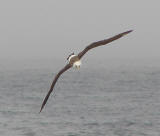
rarest and most sought-after seabirds.
Monday, 9 June
At Sirius Point, on Kiska Island, there is a huge
colony of Least and Crested Auklets. We pass by early today, and despite
foggy conditions, we can see huge flocks of these tiny seabirds on the
sea and in whirring flight. The Least Auklet, at six and a quarter inches,
is the world’s smallest seabird, and feeds on plankton. Some passengers
have a view of a Bald Eagle perched on a pinnacle, and of a Red-legged
Kittiwake, but most of the time they are hidden in the mist.
During the morning the fog clears, and two faithful
Laysan Albatrosses follow in the wake for an hour or more. It is wonderful
to have an open bridge, where we can always watch our progress and check
temperature and wind-speed. When the charts show deep water, the birding
is quiet, with only a few Fulmars and the occasional Tufted Puffin about.
But at midday we pass Semisopochnoi Island to starboard, and an area
marked Petrel Bank on the charts. Suddenly the sea is full of Least
Auklets and smaller numbers of Crested Auklets, now in perfect visibility.
They rise from the bows and form flocks like swarms of bees. Those with
keen hearing can make out their twittering above the steady whirr of
the engines. As soon as deep water returns, we lose the auklets, but
there are distant Sperm Whales taking advantage of the underwater shelf.
The afternoon passes agreeably, as it is mild enough
to relax on the stern deck, especially when the sun comes out. There
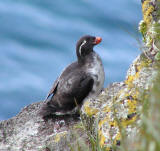
are thousands more auklets (mostly Least), plus an occasional Pomarine
Skua and Parakeet Auklet. Lars Jonsson gives a memorable talk about
his life and work before another fine dinner. As darkness falls, we
arrive at Adak Island, where we are formally cleared into the U.S.A.
The officials come on board to check us individually.
Tuesday, 10 June
Seawatching is lively this morning as we steam north-north-east
from Adak to the Pribilofs. The most dramatic increase is in Fork-tailed
Storm Petrels, which are constantly visible. The daily total must be
thousands. Often their feet can be seen pattering on the water as they
seek their planktonic breakfast. In among them are occasional Leach's,
appearing blacker, and more direct and purposeful in flight. Tufted
Puffins are common all day, with occasional Horned Puffins turning up
too. Sue is lucky enough to see a Fin Whale, which appears only briefly:
as may be expected from the "greyhound of the seas".
During the afternoon Tony and I brief the group about
tomorrow's activities on St Pauls, the principal Pribilof island, and
the only one we visit. As we talk over our plans in the sunshine on
the stern deck, two Red-legged Kittiwakes keep us company, an adult
and an immature. They are elegant and tern-like in flight, and the immature
lacks the black tail-tip and W on the wings.
Wednesday, 11 June
The sea is calm and the sky bright for our arrival
at St Pauls, the larger of the two Pribilofs. We anchor just outside
the harbour, and from deck we can see all the excitement and activity
of seabird cliff colonies of alcids. Parakeet Auklets are on the glassy
water and flying past in pairs, along with both Brunnich's and Common
Guillemots, Tufted and Horned Puffins. There are rafts of dark Crested
Auklets, and Least Auklets whirring past in swarms. The Fulmars, all
coffee-coloured at the start of the voyage, are increasingly pale at
this higher latitude.
The zodiacs take us to a low jetty in the harbour,
so we have no need for wellies! We can all choose our footwear for a
day's walking, very welcome after our days at sea. Most of the group
head off for the fur seal colony at the south-east corner of the island,
at Reef Point. There are views of all of these auks close by on the
rocks and small cliffs: the Least especially approachable on a boulder
beach. The fur seals are mostly young males, grunting and roaring and
eagerly awaiting the arrival of the females.
In the village Grey-crowned Rosy Finches are common
as sparrows, much larger and brighter than the Asian birds we saw last
week. The King Eider Hotel acts as a coffee, convenience and backpack
stop throughout the day. It is well named, since only two minutes' walk
away is a fine drake, at first standing on the sandy beach, and later
swimming out towards a group of Harlequins. Red-faced Cormorants fly
over and fish in the bay. By Salt Lagoon a pair of Semi-palmated Plovers
are on territory, and Arctic Foxes chase the kittiwakes that are loafing
on a sand-spit. Their coats are variable in colour, but mostly dark;
a few are ginger or blond. Compared with our Red Fox they are small
and delicate.
The other recommended activity is to take the shuttle
buses that have been organized for us to Ridge Wall, a long but comparatively
low range of cliffs thronged with seabirds. Here most of us enjoy our
picnic lunches in the sunshine: a rare event in the Pribilofs, which
are not renowned for good weather. We can look down on all seven auk
species, and more too. Black-legged Kittiwakes have untidy grass nests,
and among them one pair of Red-legged Kittiwakes are putting the finishing
touches to their neater one. Darker mantle and shorter bill are easy
to compare with their commoner relative. Lapland Buntings serenade us
with a tuneful song-phrase as they parachute down to the treeless heathland.
The botanists are happy too, with blue lupins, yellow rock-rose and
Potentilla, and Alaska Poppies already in flower, to name only
a few. Some of the shuttle-buses see Rock Sandpipers on the way: they
nest on the tundra here, and have a beautiful hovering display-flight.
These cliffs are a great spot to rest and catch the sun, while taking
in the comings and goings of the seabirds. Thousands of auks are also
at rest on the sea below the cliffs.
Eventually it is time to head back to the village,
where the church, gift shops and even a supermarket make popular stops.
In early evening we are back on board, with the sun still shining. In
the Observation Lounge we have the Ornitholidays drinks party, with
visits from the Captain, Conrad and Michelle the expedition leaders,
and Terry the Canadian botanist. With champagne and canapés, (not to
mention the wine at dinner), everyone enjoys an especially sociable
evening.
Thursday, 12 June
The sea is like a mirror through the night, making
for a deep sleep for us all. Glaucous Gulls are now following the ship,
instead of Glaucous-winged. Their all-white wings are admired by all
passengers. Now we are too far north for albatross, storm petrel or
shearwater. We anchor off Hall Island in mid-morning, and have time
on deck while the first half of the passengers have a zodiac cruise.
A Rock Sandpiper flies close over the bows, and thousands of auks fly
past.
Passengers arriving back from the first zodiac cruise
as we are about to set out describe the experience as the best hour
of the tour, both for birds and scenery. Sure enough, our zodiac cruise
is magnificent, with many of the seabirds swimming alongside each boat,
especially Pigeon Guillemots. They occupy the boulders near the shore
in their hundreds. Above them are Tufted Puffins, burrowing in grassy
slopes. There are tens of thousands of pale morph Fulmars too, wheeling
around the sky and nesting, with Glaucous Gulls in among them. McKay's
Buntings fly over the slopes like snowflakes, whiter still than Snow
Buntings. They are endemic breeders to four Bering Sea islands, and
migrate to Alaska in the winter. The cliff scenery is just as impressive
as the birds. The vast cliffs by Elephant Rock have ledges of guillemots
(Common and Brunnich’s), packed against each other like sardines.
During lunch we move round to nearby St Matthew Island
and anchor off a large bay, with a tundra hinterland behind. The island
is 30 miles long but uninhabited, and is the headquarters for the McKay’s
Bunting. As soon as we land we see plenty of them, pure white males
and females with streaked backs. Tony leads one half of our group up
one valley, while my route is gentler. While Tony finds Grey-crowned
Rosy Finches, we come across a series of small pools where phalaropes
are swimming. There are five Red-necked, and a single male Grey, in
its red breeding plumage. It would have been good to see its much brighter
red partner, who initiates courtship and has nothing to do with family
duties after egg-laying. It is wonderful to watch both species together,
only a few feet from us as we lie on the grassy bank. A pair of Long-tailed
Skuas fly over, and have a nest in the tundra beyond the phalarope pools.
Long-tailed Duck are establishing territory on other small ponds, and
allow a close approach. Rock Sandpipers are nesting all over the tundra,
with males display-flighting and raising a single wing. Part of their
song is borrowed from the Dunlin, like quietly screeching brakes. Both
groups find a nest with a complete clutch of four large, mottled eggs.
The flora is beautiful too, including mauve orchid-like lousewort, and
a similarly-coloured Primula.
Suddenly on the marine band radios which we carry
comes a call that an Emperor Goose has been seen on a lake, an hour’s
walk beyond where we are. A twitch! Yomping over spongy tundra and bog,
we just have time. The goose is swimming on the lake, showing grey body
and pale neck: a rare bird, here seen in a wonderfully remote spot.
We are back on the landing beach at 20.05, only five minutes after the
time arranged for the last zodiac. Everyone has had a great day on these
remote, rarely visited islands - as we can tell by the volume of conversation
at dinner.
Friday, 13 June
As we head towards Gambell, Gerald, Ashley and John
have a look round the engine room by special request. At the same time
many of us go to the auction of Robert Bateman's and Lars Jonsson's
artwork, mostly done during the voyage. All their paintings go for several
thousand dollars, with the highest price for a small painting of a family
of Red-crowned Cranes: this fetches $12,500. Proceeds go to the International
Crane Foundation: a total of $46,400.
After a briefing about tomorrow’s disembarkation,
we anchor off Gambell, the Yupik settlement at the north-west corner
of St Lawrence Island. After early fog, we have a superb sunny day,
and clear views over to the snowy Siberian Chukchi Peninsula, 38 miles
away. It is a tough walk over shingle to the north-west point of the
island, a renowned sea-watching spot. Auklets are streaming north in
flocks, mostly Crested, with many guillemots in with them - both Common
and Brunnich’s. This is the only place where we have seen more Horned
than Tufted Puffins. Five Sandhill Cranes fly right over us, heading
directly for Siberia. A friendly Grey Whale comes drifting past us,
only a few metres offshore. This species loves shallow water, but this
seems a dangerous strategy here, given the Yupiks’ traditional whale-hunting.
Ducks are represented by Goosander and Common Eider; and before we left
the ship King Eiders too. After an hour or so, Lars shouts "Spectacled
Eider!" as a young male flies past, and quickly out of sight. Luckily
it is soon relocated at the landing site, and many passengers hire the
quad-bikes which the Yupiks use as taxis to reach the bird more quickly.
Luckily it gives lengthy views - a rare and declining bird with a restricted
range.
Many people take a walk or ride round the village,
with its grim boneyards, of Bowhead Whale and Walrus. The Yupiks are
closer relatives of the Chukchis than the Aleuts. Most of their protein
comes from whale, walrus and seal meat. Cruise days must be important
for the local economy. The American passengers are seeking Siberian
vagrants to add to their U.S. lists, but not much is about: only White
and Yellow Wagtails. As we set off for Nome, on a beautiful sunny and
calm evening, Grey Whales appear around the ship.
This evening we pack, and enjoy the Captain’s farewell
party and dinner, when all the chefs are introduced, and Baked Alaskas
are carried in with ceremonial candles blazing.
Saturday, 14 June
We arrive at Nome Port at 06.30, while we are having
a final breakfast on board. Since Kushiro, we have voyaged 3,988 statute
miles. Soon afterwards, with many fond farewells to crew and staff,
we disembark, to spend a day in Nome. A big yellow school-bus is home
for the day, driven by Warren, who is a mine of information about this
unusual place. It is a remote gold-rush town, where gold was first discovered
in 1898, on the beach and inland. After two or three years, Nome had
a population of 25,000. It is a great place for coastal and tundra birding
too, with an emphasis on waders.
Just south-east of town on the Safety Sound road,
we make a first stop at an old gold-dredge that has been preserved.
Western Sandpipers feed almost at our feet, and three American sparrow
species sing in the low willow and birch scrub: White-crowned, Savannah
and the less expected Tree. Brian, searching for raptors, finds a Moose
with two calves. At the bridge over the Nome River, a lone Snow Goose
is a good find: it is far west of its usual migration routes. Red-throated
Divers swim in the estuary and fly over cackling. Waders here range
in size from Least Sandpiper to Bar-tailed Godwit.
We are scanning pools (finding Red Fox, Tundra Swan
and American Wigeon), when our mammal-spotter Brian scores again: this
time with a herd of Musk Oxen up on a hillside. There are seven lying
down, and a fine old male with shaggy coat and pale, spindly legs. A
little further on, Sandhill Cranes graze on the left, while on the right
is a close Long-tailed Skua. An Arctic Redpoll perches on a rock in
the tundra: its Common cousin is also here, mostly in more scrubby habitats.
The picnic lunch spot is just beyond the bridge at
Safety Sound. A Semi-palmated Sandpiper perches by the bus as we step
out. A brave pair of Lapland Buntings continue feeding their young in
a nest under a tussock, even while we are sitting four metres away.
A Pacific Diver in full summer plumage is out on the lagoon, and looks
exquisite in the scopes. A pair of Arctic Skuas are on territory too,
one dark and one of the pale morph. It is a brilliant day for a picnic:
cloudless and unusually warm for Nome.
At this point we turn back, and make a stop
at mile 17 to look for Black Turnstone, but without luck. The tundra
flora is beginning to bloom: notably creeping Azalea and a white
Anemone. Half of the group continue on the bus back into town,
to look round the museum and absorb the gold-rush atmosphere. The rest
of us strike out across boggy tundra by the Nome River, to see the Golden
Plovers more closely: are they Pacific or American? Good scope views
of the males reveal both species, which overlap as breeding birds in
West Alaska. They have different calls and plumage on flank and undertail.
There is also a mixed tern colony: both Aleutian and Arctic together
in the scope. The Aleutians have a chirruping, lark-like call, quite
different from the more familiar Arctic notes.
At 17.00 we meet up in town to drive the short distance
to the airport to check in for the Anchorage flight. Once we have boarding
passes, there is time to return to town to eat. By ordering earlier,
we have quick service and a filling meal at Fat Freddy's, with sea views.
The freshly caught halibut is especially popular. There is time for
a checklist as we sit outside in the warm sunshine. Back at the airport,
security is strict: we even have to remove our shoes for the x-ray machine.
The evening Anchorage flight is 80 minutes late, with Alaska Airlines
on a 737. Below us is the meandering Yukon River, and on the left is
the peak of Mount McKinley, North America’s highest mountain. By the
time we have retrieved our luggage and taken shuttle buses and taxis
to the Inlet Tower Suites, it is midnight, but still light enough for
some to see a Moose and calf in the suburbs. Some of the group are not
returning with us to Heathrow, and at various points tonight and tomorrow,
we say our farewells to them.
Sunday, 15 June
There is an opportunity to sleep in a little, as breakfast
is arranged for 08.45. But the restless few opt for an early walk to
the Westchester Lagoon, on a damp and mild morning. Black-billed Magpie
is the commonest bird: now split from our similar Eurasian species.
Certainly the long, harsh, Nutcracker-like hunger calls of the young
are very different from those that wake me up at home. Otherwise, the
prosperous and leafy suburbs reveal only Dark-eyed Junco and Black-capped
Chickadee as a light rain falls, but by the time we reach the lagoon,
it has dried up. Out on the water are many pairs of Red-necked Grebe,
one standing on a floating nest. One island is populated with breeding
Mew Gulls, plus a few visitors: Short-billed Dowitchers and Hudsonian
Godwits in superb breeding plumage. Suddenly chaos ensues as an adult
Bald Eagle flies over and scatters gulls and waders in all directions.
Three times it passes over the lake, perhaps interested in the Canada
goslings scattered over the shores. As we return for breakfast, a Downy
Woodpecker climbs a telegraph pole in front of us.
Three shuttle buses take us to the airport for the
12.06 Alaskan Airlines flight to Seattle. Luggage is x-rayed and tagged
directly through to London. Warning to future travellers from the States:
the x-rays used for checked-in cases damage photographic film! The
islands off Vancouver look magnificent in the summer sunshine. Mount
Rainier, our final snow-capped volcanic cone, continues the theme of
‘Ring of Fire’ to the very end. We land 20 minutes early, in good time
to collect boarding passes for the British Airways flight to Heathrow.
The London flight is full, and takes off at 18.40. With the eight-hour
time-change to BST, we are immediately into.......
Monday, 16 June
It is almost a nine-hour flight to Heathrow, over
Churchill and endless expanses of magnificent North Canadian tundra
in the half-light between day and night. The routing is over Southern
Greenland, Kintyre and Manchester: we land at a hot and sunny Heathrow
20 minutes early. And so we complete our amazing journey round the Northern
Hemisphere. In the baggage hall we say final farewells, with many happy
memories of our epic voyage.
Tony Pym and Simon Boyes
Ornitholidays
29, Straight Mile,
Romsey,
Hampshire,
SO51 9BB
Tel: 01794-519445
E-mail: Ornitholidays@compuserve.com
June, 2003
Our next cruise to the ‘Ring of Fire’ on the World Discoverer
will be from the 29 May to 20 June 2004 and will be led by Richard Coomber.
Prices start from £5,999.00.
Itinerary and Weather: see Extract of Ship’s
Logbook for cruise days.
Before cruise:
| 26 May |
Arrive Tokyo Narida 09.10. To Yatsu Higata Park.
Cloudy, dry, 17°C (63°F).
Fly Tokyo Haneda to Kushiro.
Cloudy, dry, 10°C (50°F) |
| 27 May |
Kushiro. Akkeshi, Kiritappu Marsh.
Dry, foggy patches. 7°C
(44°F) |
| 28 May |
Kushiro to Akan NP, via Lake Takkobu, Lake Mashu, Iousan.
Sunny, up to 21°C (70°F) |
| 29 May |
Akan NP, Lake Onneto. To Kushiro Marsh and docks.
Sunny a.m, clouding, 14-21°C
(57-70°F). |
After cruise:
| 14 June |
Safety Sound, Nome, Alaska.
Sunny, 14°C (57°F).
Evening flight to Anchorage. |
| 15 June |
Westchester Lagoon, Anchorage.
Cloudy, light rain, 17°C
(63°F).
Midday flight to Seattle; and onward to London. |
© Ornitholidays
Full
trip list and commentary (pdf)
Brochure
|