|
Thursday, 9 January
Our team of 11 arrive at Heathrow bright and early
for the flight to Port of Spain, but unfortunately we see the airport
in its worst light. After a series of delays, none of which is attributable
to the airline BWIA, we take off almost four hours late. However, there
are compensations. Bee-Wee (as the Trinidad-based airline is known)
have a new Airbus in place of the old Tristars; and we leave England
on a clear, sunny day, with a dusting of snow on the ground. After eight
and a half hours above the sea, we make a brief stop at Barbados to
drop off passengers. Soon we are disembarking at Trinidad's smart new
terminal, and retrieving our luggage. We arrive at the Asa Wright Centre
at 22.00, to a traditional rum punch welcome. Many of us do a little
justice to the Chinese buffet that has been prepared for us, before
a well-earned rest. Here we are four hours behind GMT.
Friday, 10 January
The hour before breakfast on the verandah, on the
first morning, is a special time and place. So much constant activity
of brightly coloured, unfamiliar birds! As always the Green and Purple
Honeycreepers are especially admired, along with the wide range of tanagers.
One moment of drama has two Channel-billed Toucans appearing to chase
a Grey-headed Kite out of a wild nutmeg tree. The Chestnut Woodpecker
below us is also a favourite. Luckily we will have plenty of opportunity
to get to know them all better.
After the buffet breakfast, Dave (son of Roodal,
our main driver and bird-guide) takes us along the drive for a gentle
orientation walk. It is a good time for raptors, with White, Grey and
Common Black Hawks all giving good flight views. We admire the Black-throated
Mango and Crested Oropendola in the flowering Immortelle trees, and
have various flycatchers on view: the Euler's that Adrian finds for
us poses well. But it turns out to be trogon morning. With the aid of
Dave's whistled calls, we have perfect views of all three males. First
comes the red-bellied Collared, at the end of the drive. Then Violaceous
turns up at the same spot; and finally an equally obliging White-tailed
perches in a huge bamboo.
As the lunch-bell rings, a Great Antshrike appears
below the verandah. After siesta, the verandah holds our attention until
after tea, served at 16.00. There is still constant activity, and plenty
of time to sort out similar species, such as the males of Shiny Cowbird
and White-lined Tanager, and the female honeycreepers. Both male manakins
(Golden-headed and White-bearded) appear in the Trema tree, which
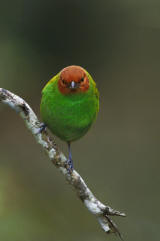
also attracts Turquoise and Bay-headed Tanagers. In the upper car-park,
a male Tufted Coquette perches in full sun, to be admired in the scope,
an exquisite jewel with flaming orange neck-ruff adorned with emerald
spots. A flock of Lilac-tailed Parrotlets offer brief views before rushing
off on one of their noisy flights; and at 18.05 we have two sightings
of note: the Short-tailed Nighthawk, and the approaching rum punch trolley.
After dinner we run through the long list of what we have seen today:
it's been a great start.
Saturday, 11 January
Before breakfast, both Great and Barred Antshrikes
come to the verandah, and a White Hawk shines like a light in the distant
canopy.
Today's outing is to Blanchisseuse, on the north
coast. First stop is for an army ant swarm, not far from the drive entrance.
Here several Plain-brown Woodcreepers are busy in the understorey, with
a few Red-crowned Ant Tanagers. Nearby two Cocoa Woodcreepers shin up
a trunk, not interested in the creatures at ground level fleeing from
the ants. Beyond the relay station at Morne Blue, the next stop is a
neck-breaking one. There are Slaty-capped Flycatcher, White-flanked
Antwren and Plain Antvireo, (among much else), but this is not easy
birding! Further down the mountain towards the coast, Rufous-tailed
Jacamars give wonderful views, like Neotropic bee-eaters.
The lunch stop is by the beautiful beach at Blanchisseuse.
The waves and currents discourage swimming, but there is some paddling
enjoyed in the warm Caribbean waters. Frigatebirds glide over us, while
a party of Brown Pelicans, smart in breeding plumage, fish offshore.
At the mouth of the Marianne River, a Little Blue Heron hides in the
reeds, while Southern Roughwing and White-winged Swallows swoop overhead.
We make two good stops on the way back. At the first,
the star is the Ferruginous Pygmy Owl, posing in the scope. All around,
the bamboos are alive with quivering wings as smaller birds mob the
predator. They include Long-billed Gnatwren, Rufous-breasted Wren, Blue-chinned
Sapphire and Golden-fronted Greenlet. A Rufous-browed Peppershrike perches
in the canopy above us and challenges us with a repeated, "you'll
never see me!" (But it’s wrong!) The final stop, for banana cake
and more juice, introduces us to a displaying Blue-black Grassquit,
known locally as Johnny Jump-up. Grey-breasted Martins, Short-tailed
and Grey-rumped Swifts fly above. There is a tantalizingly brief look
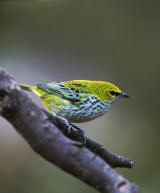
at Blue-headed Parrot and Speckled Tanager, but we will be back here
for better views, we hope, on Tuesday.
After dinner the Asa Wright Serenaders, a group of
five members of staff, sing and play us some very rhythmic Soca Parang,
which is Trinidad carnival music, sung in an English dialect so strong
as to sound quite foreign. And that, by Asa Wright standards, is real
nightlife!
Sunday, 12 January
Morning and early afternoon are at the Centre: plenty
of time to enjoy verandah, trails, and even the swimming hole. Chima
is the Asa Wright guide to accompany us down the Discovery Trail. The
wonderful antics of the male White-bearded Manakins at their lek occupy
us for half an hour. This lek has many courts, where the males clear
the ground of leaves and dance from sapling to sapling, like jumping
beans. They can spend up to 90% of their daylight hours dancing. When
they puff out their white beards, they are as round as a ball. We sometimes
see the drab, olive females elsewhere in the forest, but not at the
lek.
Not far beyond is another bearded wonder, the Bellbird,
calling with explosive volume to proclaim territory. The wattles dangling
from the chin like black spaghetti are clearly visible in the scope.
We watch the old eyrie of the Ornate Hawk Eagle, but last year's young
is not at home today - it has been seen recently. Chima shows us the
world's largest wasp, which paralyzes a tarantula and lays eggs on its
doomed body. There is also a vast leafcutter ant nest to watch and learn
about. Our return is along the Chaconia Trail, which gives us plenty
to look at, including Golden-crowned Warbler, Streaked Xenops, trogons
and motmot. After the climb back up to the main house, we are ready
for a drink and a rest. An excellent Sunday lunch and siesta follow.
As the sun continues to smile on us, Sheila, Gay,
Chisholm and I explore the delights of the semi-natural swimming pool
along the drive. The stream has in fact been dammed below a waterfall
to make an ideal pool with power-shower. On the way there, another army
ant swarm attracts Plain-brown Woodcreepers and a Barred Antshrike.
At tea-time, a Forest Elaenia appears in the Trema,
showing its usually concealed white crown. We leave at 16.30 for a spot
of dusk birding at Wallerfield. This former U.S. Airforce base has runways
still intact that date back to 1945. The stands of Mauritia palms give
us half an hour's fine birding before sunset. A Moriche Oriole and several
Sulphury Flycatchers appear immediately, while a Fork-tailed Palm Swift
flies overhead. Red-bellied Macaws fly in to roost, while a pair of
Yellow-headed Caracaras return frequently to one palm, as if planning
to nest. A wintering Merlin passes by, notably larger than European
birds. Meanwhile rum punches make a perfect sundowner, and a hot dinner
is served as the fireflies light up and dance around us.
In the first hour of darkness, both Pauraque and
the smaller White-tailed Nightjar give good views both in flight and
on the ground, thanks to bright lamps run from the vehicle batteries.
Roodal finds us a Common Potoo with great skill: it looks wonderful
in the scope, with huge eyes shining orange as it looks around for moths.
Only the Tropical Screech Owl is a no-show, but they have been elusive
recently. Saturn's ring is also a good find in the scope. Wallerfield
is a hot and humid place by day, but very pleasant in the evening. We
arrive back at the Centre at 21.00, ready to relax and digest the experiences
of another good Trinidad day.
Monday, 13 January
Activity at the feeders is as frenzied as ever: the
Motmot is a popular feature of the far table each morning at 06.20.
Only the hummer feeders are less busy than usual, as the forest is ablaze
with Immortelle (Erythrina), which provides a more natural source
of nourishment - albeit one introduced from South America. There is
a Streaked Flycatcher in the upper car-park just before the breakfast
bell rings.
We head down the hill, past the airport, and stop
at the muddy shore at Waterloo, at the south end of the Caroni Swamp.
Alas there is not enough mud: we are two hours before high tide, but
the tide is in further than expected. Still, there is plenty to see.
Turnstones and Laughing Gulls adorn the boats moored in the shallows,
while Little Blue and Tricoloured Herons are busy on the remaining mud.
Whimbrels, Willets, Southern Lapwings and Grey Plovers are either still
feeding or already resting until a lower tide. More distant, we can
make out Greater Yellowlegs and Short-billed Dowitchers (the ones with
the long bills!) in the scopes. Ospreys are plentiful, none more enjoyed
than the one that brings a fish onto the mudflats to eat. Royal Terns
squabble over perches, and a flock of Black Skimmers provide the highlight
of the morning, skimming to and fro with their unique bills. Other interesting
birds here are Wattled Jacana and Grey Kingbird.
We take a midday break at the Caroni Visitor Centre,
a great place for a picnic, overlooking the mangroves. Roodal finds
a brilliant roosting Sc*rl*t *b*s, an unmentionable species as it is
meant to be Thursday's highlight. We return via the rice-fields, where
Savannah Hawks give wonderful views, and two Long-winged Harriers are
a little less obliging. Ashford, our second driver, and Mike find a
Pinnated Bittern, or at least its neck and head. One bus has a Striated
Heron, the other a Red-breasted Blackbird - I hope that Nariva will
provide them for everyone. We are back at the Centre in perfect time
for afternoon tea.
Tuesday, 14 January
The first cup of homegrown coffee tastes wonderful,
especially with a Motmot and an Agouti to watch just below us. New hummers
appear at the verandah: Green Hermit and Blue-chinned Sapphire. The
Tityra perches in the wild nutmeg, and toucans pause in the matchwood.
After breakfast, a short drive brings us to the summit
of Morne Bleu, at about 2,000 ft. Ignoring the fierce no entry notices,
our drivers get a cheery wave from the security guards of the TV relay
station. A male Hepatic Tanager on the fence is a great start, followed
by Bay-headed and Speckled Tanagers in a fruiting Trema. A Short-tailed
Hawk of the pale morph appears at eye-level, and we have close views
of a Rufous-breasted Hermit which has flown inside Roodal's bus, through
a slightly opened window. Everyone has a good view before we open the
door to allow its escape.
A stop on the way down to see what is attracted to
an army ant swarm misfires, when the ants swarm over our ankles - but
not for long. There is no lasting damage, and in more comfortable surroundings,
we find a Blue Dacnis in another Trema. Drizzle encourages us
to return to base for lunch. After a short rest, some of us venture
out to watch manakins and bellbirds on the Discovery Trail. The manakins
are manic, as there are at least two females visiting. The males are
dancing, wing-snapping and chirruping as if there is no tomorrow, each
eager to be the chosen suitor. Some are as close as 3m from us, oblivious
of our presence. One bellbird offers perfect views too, facing us with
black wattles waving as it calls. We have clearer sightings of flycatchers
such as Boat-billed and Tropical Pewee. At the appointed hour of 18.07,
the now reliable Short-tailed Nighthawk flies round in front of the
verandah, allowing more of the group to catch up with its erratic flight:
a perfect accompaniment to the first, complimentary rum punch.
Wednesday, 15 January
Lineated Woodpecker is the star of the early session,
drumming on a dead Erythrina branch. A Rufous-breasted Wren on
the drive gives us our best views to date.
After breakfast, we set out for Nariva Swamp, with
plenty of stops along the way. First is for a Giant Cowbird, somehow
spotted by Roodal on a treetop. Along a side-road near the Aripo Cattle
Station, a Barred Antshrike sits still for all to see in the scopes.
A female Ruby-topaz Hummingbird passes by, leaving us to hope for a
male in Tobago. At the Cattle Station itself, Savannah Hawks are perched
in prominent positions, while a White-necked Heron inspects the pastures.
Water Tyrants and Marsh Tyrants take a bit of sorting out, and White-winged
Swallows fly purposefully to and fro. Red-breasted Blackbirds show off
their fine colours on the ground and in short display flights.
A bar in Valencia makes a good mid-morning stop.
A Zone-tailed Hawk flies past, cunningly imitating a Turkey Vulture.
We pause to watch the comings and goings at a Yellow-rumped Cacique
colony by the main road. At Manzanilla Beach, there is time for a swim
before lunch, enjoyed by Sheila, Mike and me. There is even a shower
in the changing room. A recently dead shearwater has been washed up
on the beach: but is it Audubon's (a Tobago breeder), or a vagrant Manx
from Europe? A look at the white undertail coverts suggests Manx, but
a measurement would be helpful. Amazingly I am able to borrow a ruler
from the lifeguard, and confirm that at 14 inches from bill to tail,
it has to be Manx. (Audubon's is 12 inches).
Continuing slowly towards Nariva, we make a hot stop
by some mangroves, where Black-crested Antshrike and Red-rumped Woodpecker
come in to the tape. The swamp area itself, now partly cultivated, still
has a great variety of birdlife. Jacanas and Striated Herons are common,
and the reedbeds hold Yellow-hooded Blackbirds and wintering Dickcissels,
already in smart breeding plumage. Roodal excels again with an Azure
Gallinule, skulking like a rail but still showing its delicate powder-blue
plumage. A nearby Purple Gallinule is gaudy by comparison.
At sunset we head for the coastal palms where Red-bellied
Macaws and Yellow-crowned Parrots fly in to roost: a perfect spot for
a rum punch sundowner. Now it's full speed ahead to the Centre, where
we arrive at 19.45. After a tasty Indian dinner and quick call of the
long checklist, we're ready for bed. Nariva is a long day, but a good
one.
Thursday, 16 January
The toucans are not at the usual perch on the matchwood,
but we soon find the reason: a swarm of bees is milling round there.
We spend time with the hummers in the upper car-park, where the Verbena
is more attractive than the verandah feeders.
After breakfast, Mukesh leads us on the Oilbird trail,
which ends at the famous cave, where we all have good views of these
strange creatures, the only nocturnal frugivore in the world. Most of
the group are surprised by their large size, and long wings as they
fly round the back of the cave. Closest to us are two chicks of about
two months old. Outside the cave is a Blue Dacnis with nesting material,
and the nests of both Rufous-breasted Hermit and White-bearded Manakin.
We just miss a Tree Porcupine, which Molly found this morning asleep
on a vine, but could not be relocated.
After lunch, we head down the hill for the final
outing, to the Caroni Swamp. On the way we stop at Trincity Waterworks,
an odourless sewage works: every trip should have one! Spectacled Caymans
lurk in the water, too close for the comfort of five Least Grebes. Among
the Snowy Egrets is one long-staying vagrant Little Egret from Europe,
with no yellow lores. Flocks of Yellow-hooded Blackbirds look brilliant
in the sun. There are plenty of Southern Lapwings, and a Yellow-chinned
Spinetail collecting pine twigs for a nest hidden in the water hyacinth.
A brief stop overlooking the Caroni rice-fields reveals
a Pinnated Bittern, or at least head and neck thereof. Nearby Ringed
Kingfisher and Osprey perch in adjacent trees. James Madoo is our boatman
for the swamp cruise, in which we explore the mangrove channels and
lakes of the Caroni Swamp. He finds us a Common Potoo asleep on a dead
stump, and a Cook's Tree Boa curled round a branch. The tide is too
high for waders or herons on mudflats, but there are plenty of Yellow-crowned
Night and Little Blue Herons. As the sun sinks, more and more Scarlet
Ibis fly in to roost with Snowy Egrets and Tricoloured Herons on an
island that rapidly turns scarlet and white. The Centre always provides
a double serving of rum punch for this expedition, so we are happy watching
the spectacle. Sheila counts over two thousand ibis, a wonderful sight
when the sun hits them. The combination of ibis and rum is a heady one,
and so we see plenty of Sanded Spotpipers on the way back.
We are back at base for our final dinner at 20.00,
a barbecue on the patio for a change. The excellent food and friendly
staff have added so much to the enjoyment of staying here.
Friday, 17 January
We take our last looks at the Trinidad birds that
do not occur in Tobago - even species as common as Kiskadees and Silver-beaked
Tanagers. Down the quiet drive to Don Eckelberry's Cottage, a Black-faced
Ant-thrush walks along the forest floor like a small rail, while a pair
of Lineated Woodpeckers feed in the Cecropia trees above. A Common
Black Hawk flies over, on the way to some stream where it can find land-crabs.
Head gardener Mr Lloyd shows us the Centre's coffee drying and roasting
processes: and many bags are sold at reception as last minute mementoes
of Asa Wright.
We leave at 10.15, and take a number of different
short-cuts through Arima. Soon we are at the new terminal, checking
in for Tobago. There is time to wander round the shops and eat the sandwiches
packed by the Centre. The 15-minute flight is in a Dash 8 Turbo-prop.
The stewardess announces that we will soon be landing, before we have
cleared the north coast of Trinidad. Gladwyn is our new driver, in a
large and spacious maxi-bus. We stop at Buccoo Marsh, now overgrown
by rushes and water-lilies, with no fresh water visible. Still, it attracts
several Black-bellied Whistling Duck and one Caribbean Coot. The scrub
round the marsh has Brown-crested Flycatcher and a Red-crowned Woodpecker,
being mobbed by a brave House Wren.
Now we sit back and enjoy the drive along the windward
road, to Blue Waters Inn in the north-east of the island. The road has
some fierce bends and hills, but also magnificent vistas over tropical
bays and beaches. At 16.00 we arrive at our new base, and relax into
the large, air-conditioned rooms, with the waves breaking just outside.
There will be plenty of time to explore the local birdlife later. For
now, it's a case of swimming and joining the Friday night drinks party
in the bar (good timing!), where the rum and wine flows free. After
a good dinner, we stroll along the seafront to see if any motmots are
roosting on our balconies....
Saturday, 18 January
...Liz and Mike are the lucky ones, with a Motmot
on their light all night. At breakfast, Rufous-vented Chachalacas are
clambering round the tree by reception like arboreal turkeys, with raucous
renditions of their own name.
Frank is our boatman and guide for the trip to Little
Tobago. The tide is just right for dry landings at both ends, but first
we use the glass bottom of the boat to admire the corals and the fish
of the reef. Frank shows us the brain coral, fire coral, and many other
amazing forms, including gorgonians, (also known as dead man's fingers).
There are giant clams, and many lovely fish such as blue tang, damselfish,
parrotfish, sergeant-major, and two exquisite species of angelfish.
This reef looks in good shape, and seems to have avoided the bleaching
that has damaged so many Australasian reefs.
We land on Little Tobago, and listen to Frank's briefing
about the island's history and wildlife. As we climb up to the seabird
viewpoint, a sharp shower forces us to seek refuge in the old wooden
house half way up. Here we see Brown-crested Flycatcher and a female
Ruby-topaz Hummingbird. The tropicbirds are a wonderful sight. We spend
half an hour or more with them, as they fly past us, long tails streaming
in the wind. We look for the single White-tailed that has been around,
but all are Red-billed. One has a nest on the ground, close to the viewpoint,
and only a few feet away. Great for photos! Brown Boobies perch on the
rocks and fly past; and at least three Red-footed Boobies can be seen
on treetop nests. One pair is a mix of the two colour morphs, white
and brown. Meanwhile frigatebirds hang menacingly in the air, mostly
juveniles.
We head back for lunch and siesta. At 16.00 half
the group meet for a gentle stroll into Speyside village. In ideal weather,
(cloudy, breezy, dry), we find a number of interesting birds along the
way. White-tipped Doves feed on the lawn by the tennis court. A Peregrine
is repeatedly dive-bombed by a Merlin, half its size. Near the old
waterwheel, there is a Little Blue Heron dismembering a huge crab, preferring
the pincers to the body; and a little further on, a Green Heron with
striking chestnut neck catches tadpoles in a ditch. After refreshments
in one of the beach cafés, Clem puts us onto a Green Kingfisher by the
creek. A Northern Waterthrush bathes in the shallows. The last birds
before dusk are Barred Antshrike and Black-faced Grassquit, one of those
oddly distributed birds to be found in Venezuela and Tobago, but not
Trinidad.
Tonight we have two motmots on our balconies, and
a series of table-tennis matches begins, with Adrian looking a likely
champion.
Sunday, 19 January
We strike up a rousing chorus of Happy Birthday for
Chisholm during the early breakfast. Just after 07.00 we leave for the
rainforest, with Gladwyn at the wheel, and his father Adolphus at the
microphone. Red-legged Honeycreeper and Rufous-tailed Jacamar appear
at the Bloody Bay Lookout, during the pre-trail comfort stop. Sheila
and I have a quick view of a White-necked Thrush too.
Most of the morning we spend on a rather muddy Gilpin
Trace, a beautiful forest trail that winds downhill along a stream.
It is often quiet for birds, but with patience we amass a good haul
of the Tobago specialities. Among the highlights are the dancing Blue-backed
Manakins, mostly young males with green backs, but one fine adult too.
Stripe-breasted Spinetails and Rufous-breasted Wrens creep along the
hillside, and a Fuscous Flycatcher performs just above us. The special
hummingbird is the White-tailed Sabrewing, once believed extinct on
the island after the 1963 hurricane. We have several flight and perched
views. Just as we leave the forest, Adolphus is delighted to find us
a Grey-throated Leaftosser, creeping up a bank the same colour as its
plumage. We even see it toss a leaf or two, before it flies across the
stream.
The picnic is back at the Lookout, where two Great
Black Hawks glide past at eye-level, and parrots show off their orange
wing-patches in flight. When a Yellow-breasted Flycatcher appears, Gladwyn
informs us that it is undergoing a name-change - to Ochre-lored Flatbill!
The Roxborough Road is quiet for birds, not surprisingly just after
midday, but we have a pleasant stroll in a beautiful forest. As we climb
back on the bus, a White-fringed Antwren gives a good view. After a
photo-stop at the Speyside Lookout, we arrive back at Blue Waters at
14.30, and relax into sea or siesta. Chisholm snorkels on Point-up Reef,
and we meet in the bar as it gets dark. Gay has kindly invited us to
a round of rum punches to celebrate Chisholm's birthday. During dinner,
we have live music from a steel-pan and keyboard, and more table-tennis
afterwards.
Monday, 21 January
We breakfast at 07.00 and start the walk up Starwood
Trace an hour later. The football-crowd chants of the chachalacas ring
round the forest all morning. Quits - of the grass and banana varieties
- keep us company too. Scrub Greenlets appear, but are more often heard
than seen. A Ruby-topaz male finally gives us good views, feeding at
the pink flowers of an Acacia-type. The panorama over the sea
to Little Tobago is wonderful, occasionally adorned by frigate or Osprey.
| |
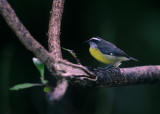
The Ubiquitous Bananaquit!
|
On the return walk, Clem and I try the Waterwheel
Trail, from top to bottom, and find it clear enough. Along the way are
four Great Black Hawks and a Red-crowned Woodpecker. There is another
good view of male Ruby-topaz feeding on pea-flowers by the ruined watermill.
By the time we return, Gay and Chisholm have gone off to the Angel Reef
for serious snorkelling in Frank's boat. They report good fish, a turtle,
and flying fish flying. The rest of the group is either on the beach
enjoying the breeze or in the warm sea.
The wintering flock of Turnstones numbers about 30
this year, including one with a silver ring and a number of coloured
ones. They often hop up the steps from beach to bar, and can be persuaded
to take crumbs from the hand, (though they don't like pineapple). It
is strange to wander through a bar with Turnstones milling around the
feet and the chairs, tamer than sparrows. Most of us repeat Saturday's
evening ramble into Speyside, watching Ruby-topaz and Pale-vented Pigeon
along the way. The group prefers tea and cakes at Jemma's to a Carib
at Frank's Bar - thanks for treating us Robin.
After rum cocktails and dinner, there is checklist,
table tennis and live music (of sorts) in our own air-conditioned meeting
room.
Tuesday, 21 January
Adrian and I brave the Waterwheel Trail before breakfast,
coming across a superb Yellow-crowned Night- Heron by the old sugar
mill. White-fringed Antwren and Barred Antshrikes seem to be everywhere.
After a sharp shower, we find Scrub Greenlet and a Chivi Vireo.
After breakfast, one of the local characters, Pussycat,
comes in his air-conditioned maxi-bus to take us to Flagstaff Hill and
Charlotteville for the morning. From the hilltop, we can scope distant
boobies and frigates on St Giles, which won't be so distant this afternoon.
A stroll along the track gives us views of two birds I associate with
lowland Trinidad, not upland Tobago: Red-rumped Woodpecker and White-winged
Becard. There is plenty of activity after the rain, both among the large
and obvious (parrot, oropendola, ani), and the inconspicuous (antwren,
grassquit, etc). Ruby-topaz shows up well, and three Jacamars are exquisite
and confiding.
Pussycat always enjoys the Charlotteville tour, as
he is so proud of the place. He even does a detour to show us his house.
It is a beautiful village, set around a lovely natural bay. We watch
the frigates, gulls, pelicans and one Brown Booby for a while before
we head back to another good lunch at base: the shrimp roti is
a popular choice.
After siesta, nine of us have opted to visit St Giles,
in a fast boat chartered by Frank from the Dive company. Sheila and
Clem stay behind, and successfully hand-feed the Turnstones with bread.
'Hanging around bars' should be added in the ornithological literature
to the range of their habitats. The crossing to St Giles is, shall we
say, invigorating, in the waters where the Atlantic swells meet the
calm Caribbean. The boat circles the main island and many of the offshore
stacks, where all three boobies give good views. The colony of Masked
Boobies has grown to 20 birds, all together on one bare, diagonal rock.
The frigates (Frank calls them frijits) are the most abundant bird,
nesting up on St Giles in their thousands. At one point they all take
to the air at once, an amazing sight. They can often be seen pursuing
tropicbirds or boobies. Robin, Connie and I have a big wave in our faces
and laps on the way back, but the water is warm and we are prepared
for it.
The evening starts with a round of drinks offered
by Ornitholidays, followed by a leisurely dinner. Amid much good humour,
Adrian accepts the table-tennis gold medal. Connie and Robin win the
consolation prize of most faithful motmot roosting.
Wednesday, 22 January
The morning is calm and sunny, and at leisure. Chisholm,
Gay and I snorkel on the Angel Reef and enjoy the great variety of coral
and fish very much. Shrimps and pasta make a good lunch choice, before
we leave Blue Waters. It really is a magical, idyllic setting. Adolphus
drives us to the airport, where we get our luggage checked through to
London, and even the boarding passes for the long flight. There are
no Caribbean Martins to be found: normally an everyday Tobago bird.
We have two hours at Piarco Airport in Trinidad,
time for a snack and a wander through the duty-free shops. The hirundines
flying round are White-winged Swallows, not the more expected Grey-breasted
Martins. At 19.00 we take off for Antigua, where more passengers join
us. From here it is just over seven hours to Heathrow, through the night.
We arrive on time at 08.25 GMT, Thursday morning, and quickly retrieve
baggage. One round of fond farewells, and we are off to our various
corners of the UK.
Simon Boyes
Ornitholidays
29, Straight Mile
Romsey
Hampshire
SO51 9BB
Tel: 01794-519445
E-mail: Ornitholidays@compuserve.com
February, 2003
Our next tours to Trinidad & Tobago are from the
25 January to 08 February 2004, led by Mike Witherick and 06 March to
20 March 2004, led by Paul Rogers. The cost per person in a twin/double-bedded
room £2,799.00 and £3,179.00 per person in a single room. Our Christmas
tour departs on the 18 December 2004 and returns on the 01 January 2005
and will be led by Mike Witherick. The cost per person in a twin/double-bedded
room £3,199.00 and £3,579.00 per person in a single room.
Our tours in 2005 are 23 January to 06 February,
led by Mike Witherick and 05 March to 19 March led by Richard Coomber.
The cost per person in a twin/double-bedded room £2,899.00 and £3,279.00
per person in a single room.
Itinerary and Weather
| 9 Jan
|
Arrive Piarco Airport 20.00. To Asa Wright Nature Centre (AWNC).
Dry, 25°C (77°F) |
| 10 Jan |
AWNC.
Dry, partly sunny, 21-28°C (70-82°F) |
| 11 Jan |
AWNC to Blanchisseuse.
Dry, mostly sunny, 21-31°C (70-88°F) |
| 12 Jan |
AWNC trails. Wallerfield night birding.
Dry, sunny, 21-28°C (70-82°F) |
| 13 Jan |
AWNC. Waterloo, Caroni Rice Fields.
Dry, sunny, 21-31°C (70-88°F) |
| 14 Jan |
AWNC. Morne Bleu.
Light showers, 21-28°C (70-82°F) |
| 15 Jan |
AWNC. Aripo Cattle Station. Manzanilla Beach. Nariva Swamp.
Sunny, 21-32°C (70-90°F) |
| 16 Jan |
AWNC: Oilbirds. Trincity Sewage Works. Caroni Swamp.
A few showers, 21-28°C (70-82°F) |
| 17 Jan |
AWNC to Piarco Airport. Fly to Tobago. Buccoo Marsh. To Blue
Waters Inn (BWI).
Sunny, 21-32°C (70-90°F) |
| 18 Jan |
BWI. Little Tobago. Speyside.
Cloudy, showery, 28°C (82°F) |
| 19 Jan |
BWI. Rainforest: Gilpin Trace. Bloody Bay Lookout.
Dry, sunny, 25-30°C (77-86°F) |
| 20 Jan |
BWI. Starwood Trace. Speyside.
Dry, sunny, 28-32°C (82-90°F) |
| 21 Jan |
BWI. Waterwheel Trail. Flagstaff Hill. Charlotteville. St Giles.
A few showers, mostly sunny. 28-32°C (82-90°F) |
| 22 Jan |
BWI. To Airport. Fly to Trinidad. Depart 19.00.
Sunny, 28-32°C (82-90°F) |
© Ornitholidays
Full
trip list and commentary (pdf)
Brochure
|