Visit your favourite destinations
|
Visit your favourite destinations |
| A Report from birdtours.co.uk |
Costa del Sol (27/3/99-3/4/99),
Introduction
What follows is an account of a trip that I made to the Costa del Sol during Easter 1999. I stayed at the "Los Amigos beach club" situated about two miles west of Fuengirola. This was a family holiday and so most of my birding was done during the first couple of hours of daylight. (However as the day dawned at 8.00am this was hardly a sacrifice!)
Given the time of year I was unsure about which species would be present and so I was pleasantly surprised at the number of summer visitors that had arrived. In addition to these, the nearby Sierras held a good variety of mountain species, especially birds of prey.
The weather was excellent, every day was like a British summer without the overbearing heat that characterizes this area in July and August.
The sites.
Most of these sites can be reached in little more than an hour (and often quicker) from any of the resorts on the Western Costa del Sol. Estapona, San Pedro, Marbella, Fuengirola and Torremolinos are all well placed.
By the apartment!
The road west from Fuengirola passes under the only lighthouse hereabouts, called the Faro y Torre. The road junction immediately after this leads to the Los Amigos Beach Club. Park here. A track now leads inland through some typical Meditteranean scrub with a tiny willow and reed lined stream.
The area was alive with Cetti's Warblers and Nightingales, both giving good views. The Nightingales had arrived the previous week. Serins and Sandinian Warblers were everywhere. Obvious new arrivals included a Woodchat Shrike and two waves of Pallid Swifts. (Ordinary Swifts arrive about mid-April. ) The only Starlings were Spotless. Hoopoe and Crested Lark also featured.
Without repositioning the car it is possible to walk down to the headland. (About 100m and through an underpass.) This is potentially a good seawatching spot as this part of the Costa sticks out more than most. My brief visit produced four Audouins Gulls loafing offshore, a few distant Med Shearwaters, Gannet, Little Egret and a few Sandwich Terns.
Refugio de Jaunar
Very easy to access, being just a few miles inland from Marbella. This is a mountain site and probably best visited a couple of weeks later than I did when more species are in. The walking is beautiful. After parking near to the Refugio follow tracks to the Mirador and superb views down to Marbella. A fine variety of overflying raptors had been promised, Blue and Rock Thrushes and Orphean and Bonelli's Warblers with Eagle Owls near the Mirador. They all failed to materialise but I did manage to add Jay plus Blue and Coal Tits to my Spanish list. Well worth the effort!
Serrania de Ronda
A visit to Ronda is a must even if you are not bird watching. Unfortunately most of Spain thinks this way too and so parking and congestion are a problem if you don't arrive before the hoards. Allow a full day. I didn't, and ended up having to miss some of the sites. It is possible to do a circular tour off the area. I took the main road from San Pedro to Ronda and returned via the the more minor road through Coin and back down to Fuengirola.
The key site in Ronda is the Bridge over the "Tajo", a very deep gorge. Many Chough nest here as do Crag Martins and Lesser Kestrel. Alpine Swift should be present but I didn't see any. Peregrines hunt the Rock Doves. There is a fine walk along the cliff top to the north of the town where further views of similar species will be seen. White Wagtail, Serin and Blackcap frequent this area.
The road from Ronda to Coin leads through the Sierra Blanquilla. Parking spaces were few but the region 8-11km out of Ronda was particularly worthy of stopping and scanning. Chough were again numerous. Lesser Kestrel, Golden Eagle, Southern Grey Shrike and Spotless Starling all showed well. A gorge called the Puerto del Viento and a flat area just beyond it were rewarding.
Other worthwhile stopping points are Tolox, the Mirador del Guardia Forestal and Jorox Gorge.
The Rio Guadalhorce Estuary (Malaga)
This prime wetland seems to be no longer accessible due to the building of an eastern channel to the Rio Guadalhorce which completely cuts off the area. At the time of writing, construction is ongoing. It is possible that when construction finishes, it may be possible to ford the river during a dry summer. At present this is not possible! If anyone can update me on the situation, please e-mail me.
I rescued something from my visit by driving down to the mouth of the original (western) branch of the river at Guadalmar. Best birds were a Purple Heron, Med Gull and Little Egret, with Fan-tailed and Cetti's Warbler in the reeds. (Update Aug'99)
El Chorro
This is a stunning area of cliffs, deep gorges and lakes some forty miles NW of Malaga. There are several areas which are well worth exploring.
The Valle de Abdelajis is situated below a line of high limestone cliffs about 1km east of the village of Abdelajis. However, it is probably best to approach from El Chorro village. Griffon Vultures and Bonelli's Eagles both originate from this area but apparently disperse widely soon after the sun rises. Black-eared Wheatears and Corn Buntings were also seen.
The Garganta del Chorro is the prime site of the area. It is best to park at the "El Pilar" bar. From here you can scan the sky for raptors (especially Griffon Vultures), gaze in awe at the chasm with its hundreds of wheeling and swooping Alpine Swifts and Crag Martins or look for passerines in the steep pine woods behind. The cliffs hold Choughs and in winter, Wall Creepers.
Continuing along the road, one comes to a sign on the left to the Ruinas de Bobastro. The road leads to the very top of the hill above El Chorro, were it is possible to have eye to eye contact with the same soaring raptors seen from below. There is a handy Bar and on a clear day there is a view all the way to the Sierra Nevada. The road up the hill produced several Rock Buntings along with several more familiar species.
The Parque de Ardales is a beautiful area of pine fringed lakes about five miles NW of El Chorro. The lakes have few birds but the trees have Crested Tit, Rock Bunting, Serin and Crossbill. There are many tracks to explore. Red-necked Nightjars and other migrants inhabit the area in summer.
Montes de Malaga
Situated just a few miles north of Malaga, these pine clad mountains are well worth a visit. However, without local knowledge finding the correct road out of Malaga is difficult! It is easier, though further, to drive north from Malaga on the N321, turn left at Casabermeja, left again at Colmenar and then drive 14km south to the Fuente de la Reina, the main entrance point.
There are miles and miles of driveable tracks, all colour coded. It is difficult to know where to stop. This is a site that holds Azure-winged Magpie though I failed to see any. Raptors should be plentiful and there are many view points for scanning. Most of the common woodland species occur here including Short-toed Tree Creeper and plentiful Crossbills. Three Bee-eaters flew north, presumably early migrants.
Gibraltar
No trip to the area would be complete without a visit to Gibraltar. It should be pointed out that this site comes into its own during westerly winds at migration time. My afternoon (tourist) visit to the Rock coincided with the visible migration of just one Sparrowhawk! (Apparently Black Kites had been prominent earlier in the day.) Barbary Apes were much easier to see though the partridges of the same name become very shy when the tourists arrive.
Currently the border crossing can be difficult due to political reasons of the Spanish Government. I drove straight in but was held up for an hour on the way out.
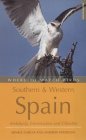 |
Where to watch birds in Southern and Western
Spain
|
John Girdley (16/4/99)
The Birds
|
Birds Seen |
Comments and locations |
|
Little Grebe |
One or two at the Rio Guadalhorce Estuary |
|
Mediterranean Shearwater |
Seen distantly offshore from the Faro y Torre. |
| Gannet | One from the Faro y Torre. |
| Purple Heron. | One, probably newly arrived, at the Rio Guadalhorce Estuary. |
|
Little Egret |
Relatively common. Seen in several places |
|
Mallard |
Odd ones seen |
| Griffon Vulture | Up to three together in the El Chorro area. Two at the Valle de Abdelajis. |
| Sparrowhawk | One in the Montes de Malaga. One north bound migrant at Gibraltar. |
| Buzzard | One in the Montes de Malaga. |
| Booted Eagle | One hunting the fields near Pizarra, about 20km south of El Chorro. |
| Bonelli's Eagle | One at Valle de Abdelajis about an hour after dawn. |
| Golden Eagle | One at El Chorro. One in the Sierra Blanquilla. |
| Lesser Kestrel | At least one pair at at Ronda and others in the Sierra Blanquilla. |
|
Kestrel |
A few seen in the mountains. |
| Peregrine | One at Ronda. |
|
Red-legged Partridge |
Heard calling at several upland sites. |
|
Moorhen |
One at the Rio Guadalhorce Estuary. |
|
Coot |
Several at the Rio Guadalhorce Estuary. |
|
Sanderling |
Three on the rocks (surprisingly) at the Faro y Torre. |
| Turnstone | Four on the rocks at the Faro y Torre. |
| Mediterranean Gull | One at the Rio Guadalhorce Estuary. |
|
Black Headed Gull |
Lots at the Rio Guadalhorce Estuary. |
|
Audouins Gull |
Four loafed offshore at the Faro y Torre. |
|
Yellow-legged Gull |
Hundreds on breeding territory at Giraltar. Odd one seen elsewhere. |
| Lesser Black-backed Gull. | About fifty, mainly immature, birds off the Faro y Torre. |
|
Sandwich Tern |
Four at the Faro y Torre. |
|
Rock Dove |
Fairly common. |
|
Collared dove |
Reflecting this species spread into southern Spain, a pair were on territory by the Rio Guadalhorce Estuary. |
| Cuckoo | One calling in the Montes de Malaga. |
|
Pallid Swift |
Sizeable arrivals during the last week of march. No common swift seen! |
| Alpine Swift. | Flocks of over a hundred around El Chorro. |
|
Bee-eater |
Three northbound migrants at the Montes de Malaga. Ten in fields near the Rio Fuengirola. |
|
Hoopoe |
One near my apartment |
|
Green Woodpecker. |
Several heard calling in various well wooded mountain areas. |
| Great-spotted Woodpecker. | Seemingly common in the Montes de Malaga. |
|
Crested Lark. |
Widespread, but never in large numbers. No Thekla's seen. |
|
Sand Martin |
Three northbound migrants from the apartment. |
|
Crag Martin. |
Common in the mountains especially on the cliffs of Ronda and around El Chorro. |
|
Swallow. |
Fairly common. |
|
Red-rumped Swallow |
Two on roadside wires about 5km south of El Chorro. Probably recent arrivals. |
|
House Martin |
Abundant in coastal towns. Seemingly nesting on every apartment block. |
|
White Wagtail |
A few seen at Ronda. |
| Nightingale | Very common near to my apartment. Ten territories within half a mile. Sometimes singing from the wires! |
| Stonechat | Several by the apartment. |
|
Blackbird |
Fairly common (but they seem much thinner than ours!) |
| Cetti's Warbler | Very common near to my apartment. Widespread. |
|
Fan-tailed warbler |
A few in estuarine scrub. |
|
Sardinian Warbler |
Abundant but not always easy to see. |
| Chiff Chaff | One in scrub land close to my apartment. |
| Long-tailed Tit | A few seen in the Montes de Malaga. |
| Crested Tit | Several in the pine forests of the Parque de Ardales near El Chorro. |
| Coal Tit | Regularly seen in all upland forest. |
| Blue Tit | As above. |
|
Great Tit |
As above. |
| Short-toed Tree Creeper | Two in the Montes de Malaga. |
|
Southern Grey Shrike |
Seemed rather thin on the ground! One in the Sierra Blanquilla. |
|
Woodchat Shrike. |
One obvious migrant near to my apartment. |
| Chough | Common in suitable habitat, especially at Ronda, the Sierra Blanquilla and El Chorro. |
|
Spotless Starling |
Fairly common. No common Starlings seen. |
|
House Sparrow. |
Common near human habitation. |
| Chaffinch | Several seen in the mountains. |
|
Serin |
Abundant everywhere! |
|
Greenfinch |
Common. |
|
Goldfinch |
Very common. |
| Linnet | A few near my apartment. |
| Crossbill | Common in the mountain pine forests, especially in the Montes de Malaga. |
| Corn Bunting | One singing at the Valle de Abdelajis. |
|
Rock Bunting |
Several seen, mainly in the Parque de Ardales and El Chorro regions. |
Collins Bird Guide Europe's best Field guide?
Why not send us a report, or an update to one of your current reports?